Hair Transplant
Beard Transplant in Turkey: Cost, Grafts and What to Expect
Reviewed by admin · Last updated June 22, 2026
Facial hair has become one of the fastest-growing areas of hair restoration, and a beard transplant in Turkey is now a common reason international patients travel for treatment. Whether the goal is to fill patchy areas, cover a scar, or build a fuller, more defined beard, the procedure relocates healthy follicles into the beard region where they continue to grow naturally. Understanding how graft counts are decided, what drives the cost, and what recovery involves helps you plan realistically and choose a clinic with confidence.
How a beard transplant works
A beard transplant uses the same follicular extraction principles as a scalp procedure. Individual follicles are harvested, most often from the back of the scalp, where the hair tends to be resistant to typical loss and closely matches the calibre of beard hair. The surgeon then implants these follicles into the beard area, paying close attention to the angle, direction and spacing so that the result blends naturally with any existing growth. Facial work is particularly demanding because even a small error in angle is visible up close, which is why precision and experience matter so much here.
How graft numbers are decided
There is no single graft number that suits everyone. A patient with small, isolated gaps may need only a few hundred grafts, while someone building a full, dense beard from sparse growth may need several thousand. The figure depends on the size of the area, your current density, the thickness of your hair and the look you want. A good clinic assesses these factors individually rather than quoting a one-size-fits-all number, and a careful surgeon will also avoid over-harvesting your donor area, since that supply is finite and may be needed in future. Our guide on how many grafts you need explains this principle in more depth.
What affects the cost
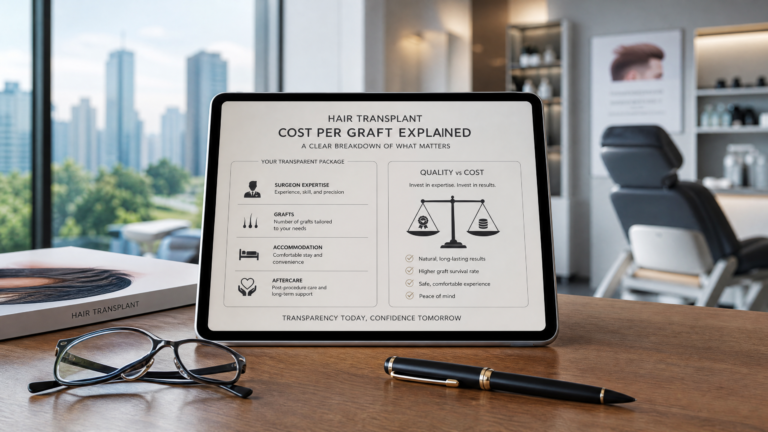
Beard transplant pricing is shaped by several factors: the number of grafts, the technique used, the experience of the surgical team, and what the package includes such as accommodation, transfers and aftercare. Many Turkish clinics quote a fixed package price covering a defined range of grafts rather than charging strictly per graft. Because prices change over time and differ between clinics, the most reliable approach is to obtain a personalised quote and confirm exactly what is and is not included. Be cautious of unusually low headline prices, which can signal shortcuts in care; our guide on how to spot a hair mill is worth reading before you book.
Recovery and the growth timeline
Recovery from a beard transplant is generally quicker than many expect, though it follows a predictable pattern. In the first days there will be tiny crusts around each graft, which gradually fall away over roughly a week to ten days. The transplanted hairs then typically shed in the following weeks, which is a normal and expected part of the cycle rather than a sign of failure. New growth usually begins around the third or fourth month, with density continuing to build and the final result becoming clear at around twelve months. Patience through the shedding phase is important, as the early appearance does not reflect the final outcome.
Choosing the right clinic
Because facial work is so unforgiving of error, clinic choice is critical. Look for direct involvement of an experienced surgeon in planning the design and performing the most critical steps, clear explanation of the graft count and the design logic, and realistic before-and-after examples in beards similar to yours. A written aftercare plan and reachable support after you return home are equally important. Avoid clinics that rush the decision, push a single graft number regardless of your needs, or treat facial work like an assembly line. Our guide on surgeon-led versus technician-led procedures explains why this distinction matters.
How Rexalife Helps
Rexalife is a medical tourism consultancy that connects international patients with verified clinics and surgeons in Turkey. We do not perform procedures or give medical advice. What we do is help you find reputable, licensed clinics, understand what a realistic plan looks like, and coordinate consultations, quotes and the practical side of your visit. Decisions about graft counts, technique and suitability always rest with your surgeon after a proper assessment; our role is to make the process transparent and straightforward. Patients planning facial work often also explore our guide on eyebrow transplants.
Conclusion
A beard transplant in Turkey can deliver a fuller, natural-looking beard when it is planned carefully and performed by experienced hands. Graft counts and costs are individual, recovery is relatively quick but unfolds over about a year, and the quality of the clinic makes all the difference in such precise facial work. Approach it with realistic expectations, a personalised plan and thorough clinic research, and the result can be both natural and long-lasting.
Frequently Asked Questions
How many grafts does a beard transplant need?
It varies widely with the goal, from a few hundred grafts to fill small patches up to several thousand for a full, dense beard. The number depends on your existing growth, the area to be covered and the density you want, so a personalised assessment is needed rather than a fixed figure.
How much does a beard transplant cost in Turkey?
Costs depend on graft count, technique and what the package includes, and clinics often quote a fixed package rather than a strict per-graft price. Because figures change and vary by clinic, the most reliable approach is to request a personalised quote and confirm exactly what is covered.
Is a beard transplant permanent?
The transplanted follicles are usually taken from the back of the scalp, an area resistant to typical hair loss, so results are generally long-lasting. Final density develops over roughly twelve months as the grafts settle and grow.
Does beard hair come from the beard or the scalp?
Most clinics use donor follicles from the back of the scalp because they closely match beard hair in calibre and provide reliable density. Your surgeon decides the best donor strategy based on your individual hair.
About the author
admin — RexaLife medical content team. All health content is reviewed by qualified professionals.
Have questions about this topic?
Speak with a dedicated coordinator. No obligation — your information stays private.
RexaLife is a medical tourism facilitator and healthcare concierge service. RexaLife is not a hospital, clinic, or medical provider and does not provide medical care, diagnosis, or advice. All treatments are delivered by independent, accredited partner providers. Information on this page is general and does not replace professional medical consultation. Costs are estimates and depend on the chosen provider.