Hair Transplant
Female Hair Transplant & the Ludwig Scale Explained
Reviewed by admin · Last updated July 15, 2026
Hair loss is often framed as a male issue, but it affects many women too, and a female hair transplant is an increasingly common reason women research treatment abroad. The way female hair loss presents, how it is classified and who makes a good surgical candidate all differ meaningfully from the male experience, which is why understanding the Ludwig scale and the importance of proper diagnosis is the right starting point.
Why women lose hair differently
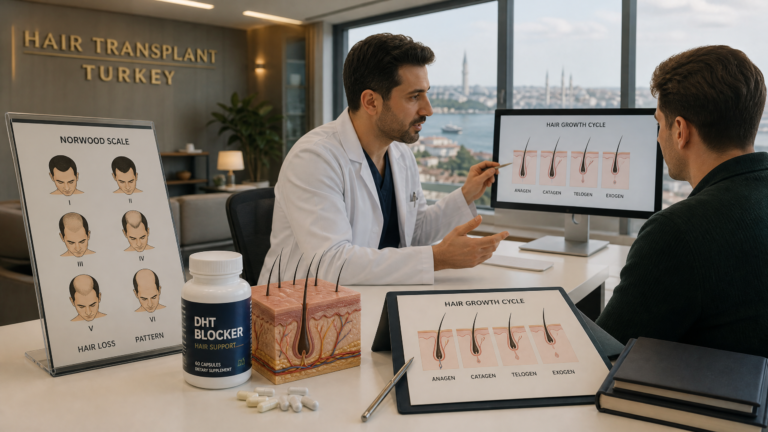
Most men with genetic hair loss follow the familiar pattern of a receding hairline and a thinning crown. Women usually experience something quite different: a diffuse thinning spread across the top and central scalp, frequently while the frontal hairline stays intact. The thinning often begins at the part line and gradually widens. Because this pattern does not match the male Norwood scale, a different classification system is used.
The Ludwig scale
The Ludwig scale was developed specifically to describe female pattern hair loss. It maps the severity of diffuse thinning across the central scalp in stages, from mild widening of the part to more pronounced thinning with a visible reduction in density. A related system, the Sinclair scale, is also used. These tools help a specialist communicate the pattern and severity, and they underline an important point: female loss is its own clinical picture, not simply a milder version of male baldness.
Diagnosis comes first
This is the single most important message for any woman considering surgery. Female hair loss has many possible causes beyond genetics, including hormonal changes, thyroid issues, nutritional factors, stress and certain medical conditions. A hair transplant addresses genetic, pattern-type loss with a stable donor area, but it does nothing for thinning driven by an underlying medical cause. That is why a proper evaluation by a specialist, often a dermatologist, must come before any surgical plan. Restoring the wrong kind of hair loss leads only to disappointment.
Who is a good candidate
The key question for any candidate, male or female, is the donor area. Women with a stable, dense donor zone at the back of the head and a clearly defined area of thinning can be excellent candidates. The difficulty is that some women have a more diffuse, unpatterned thinning that also affects the donor region, which can rule out surgery because there is no truly permanent hair to harvest. Understanding the distinction between patterned and unpatterned diffuse loss, explored in our guide on DPA versus DUPA candidacy, is central to female assessment.
The no-shave question
For many women, the idea of shaving the entire head is a major barrier. Fortunately, a number of clinics offer approaches that allow harvesting and implantation without shaving the whole head, working through existing longer hair. Whether this is suitable depends on the case, the area being treated and the surgeon’s technique, but it is well worth asking about. You can learn more in our guide to unshaven versus shaven transplants.
Alternatives worth knowing
When surgery is not suitable, women still have options. Medication may help stabilise and thicken existing hair, and scalp micropigmentation can add the appearance of density at the part line. A good clinic will discuss the full range rather than pushing surgery on everyone. Our broader guide to hair transplants for women in Turkey covers the journey in more detail.
How Rexalife helps
Rexalife is a consultancy connecting patients with verified clinics and surgeons in Turkey; we do not perform surgery or provide medical advice. For women, we place particular emphasis on reaching clinics that insist on proper diagnosis first and that offer no-shave options where appropriate. The decision about candidacy and the right treatment always rests with the treating specialist after a full assessment.
What the journey looks like for women
For women considering treatment abroad, it helps to know what a thoughtful journey involves from start to finish. It begins not with surgery but with diagnosis: a proper evaluation to establish the cause of the thinning and to confirm that the donor area is stable enough to support a transplant. Only then does planning begin, ideally with a no-shave technique discussed where it matters to you. Many women also value discretion throughout the process, from consultation to recovery, and a good clinic understands and respects that. Recovery follows the same broad timeline as for men, with early shedding followed by gradual regrowth over roughly a year. Because female loss can have ongoing medical components, follow-up and, where appropriate, continued medical management under a doctor’s care are often part of the long-term picture. Understanding this full arc, rather than focusing only on the operation itself, helps women approach restoration with realistic expectations and choose a clinic that treats female patients as a distinct group with distinct needs, not as an afterthought to male surgery.
Conclusion
A female hair transplant can be a genuinely effective treatment, but only within the right framework: female loss is classified by the Ludwig scale, it has many possible causes, and diagnosis must precede any surgical plan. Candidacy hinges on a stable donor area, no-shave techniques make the process more practical for many women, and alternatives exist when surgery is not suitable. Approached carefully and with the right specialist, restoration can be both natural and discreet.
Frequently Asked Questions
How is female hair loss different from male pattern baldness?
Women typically experience diffuse thinning across the top of the scalp, often while keeping the frontal hairline, rather than the receding M-shape and crown loss seen in men. This pattern is classified with the Ludwig scale rather than the Norwood scale.
Are women good candidates for hair transplants?
Some women are excellent candidates, particularly those with a stable donor area and a clearly defined area of thinning, but others are not because their donor zone is also affected. A specialist assessment is essential before assuming surgery is suitable.
Why do women need a specialist evaluation first?
Female hair loss has many possible causes beyond genetics, including hormonal and medical factors, so a proper diagnosis is needed before considering surgery. Treating the wrong cause with a transplant can lead to disappointment.
Will I need to shave my head for a female hair transplant?
Not necessarily. Many clinics offer techniques that work without shaving the whole head, which is often important for women, though suitability depends on your individual case and the surgeon’s approach.
About the author
admin — RexaLife medical content team. All health content is reviewed by qualified professionals.
Have questions about this topic?
Speak with a dedicated coordinator. No obligation — your information stays private.
RexaLife is a medical tourism facilitator and healthcare concierge service. RexaLife is not a hospital, clinic, or medical provider and does not provide medical care, diagnosis, or advice. All treatments are delivered by independent, accredited partner providers. Information on this page is general and does not replace professional medical consultation. Costs are estimates and depend on the chosen provider.