Hair Transplant
Diffuse Thinning & Hair Transplants: DPA vs DUPA Candidacy
Reviewed by admin · Last updated July 14, 2026
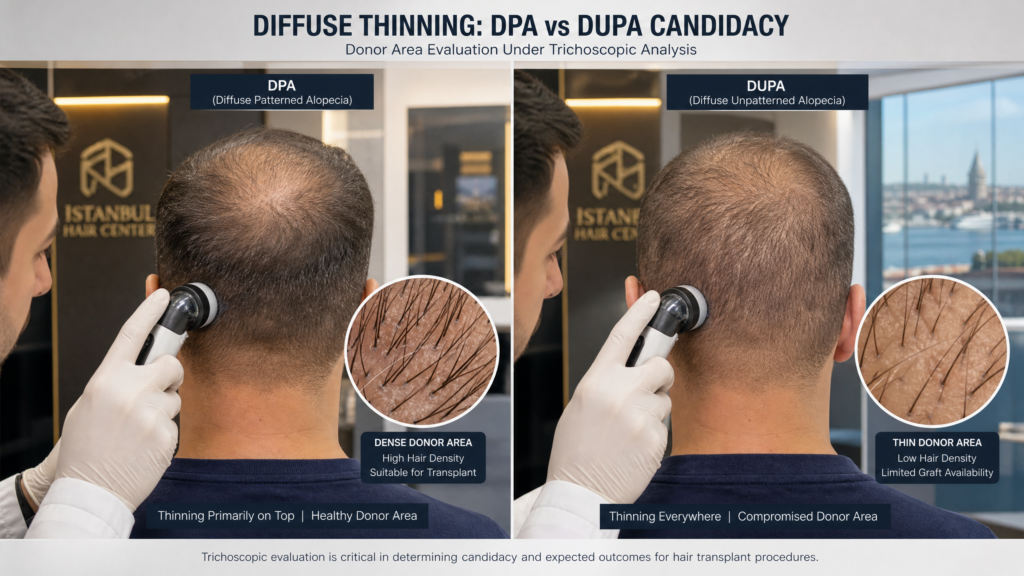
Thinning that spreads evenly rather than receding in a clear pattern raises a crucial question about surgical suitability, and a diffuse thinning hair transplant is only appropriate for some of the people who search for it. The deciding factor is a distinction that many patients have never heard of but that surgeons consider one of the most consequential in the entire field: the difference between DPA and DUPA.
What diffuse thinning looks like
Unlike the classic male pattern of a receding hairline and balding crown, diffuse thinning spreads across the top of the scalp without a sharply defined shape. Hair simply becomes finer and sparser over a wide area. This presentation is common in women but also occurs in men, and because it does not follow the usual Norwood pattern, it requires especially careful evaluation before any thought of surgery.
DPA: diffuse patterned alopecia
Diffuse patterned alopecia describes thinning that spreads across the top of the scalp while the donor area at the back and sides remains stable and resistant to the hormonal process that drives hair loss. This is the encouraging scenario. Because the donor zone holds firm, these patients have a reliable supply of permanent follicles to harvest, and many make good surgical candidates, particularly once their loss has been stabilised with medication. The donor area is, as always, the foundation of a successful transplant.
DUPA: diffuse unpatterned alopecia
Diffuse unpatterned alopecia is the more difficult picture. Here the thinning affects the entire scalp, including the donor zone itself, which is also miniaturising. This is the critical problem: a transplant relies on the principle that donor follicles keep their original programming when moved, so if the donor hair is itself destined to thin, transplanted hair will follow the same fate. For this reason DUPA usually rules out surgery, because there is no genuinely permanent hair to relocate. DUPA is relatively uncommon but is over-represented among unsatisfactory transplant results, which is exactly why screening for it matters so much.
How the two are distinguished
Telling DPA from DUPA is a clinical skill. A specialist examines the donor area closely, often under magnification, to look for signs of miniaturisation in the back and sides. A stable, uniform donor zone supports a diagnosis of DPA and opens the door to surgery, while a thinning, variable donor zone raises the suspicion of DUPA and counsels against it. This is one of the strongest arguments for a thorough, unhurried consultation with someone who examines the donor area properly rather than just the visible thinning on top.
The role of stabilisation
For DPA patients, surgeons frequently recommend stabilising hair loss with medication before operating. This protects existing hair, allows the true pattern to declare itself, and ensures the donor area is assessed accurately. Rushing to surgery on an actively thinning, unstabilised scalp risks both a poor result and a misjudged donor harvest, which is why stabilising first is so often the responsible path.
Options if surgery is not right
A diagnosis of DUPA is not the end of the road; it simply redirects the plan. Medical therapy may help slow loss and thicken existing hair, and scalp micropigmentation can add the visual impression of density without surgery. The goal is to match the treatment to the biology rather than forcing surgery where it cannot succeed.
How Rexalife helps
Rexalife is a medical tourism consultancy that connects patients with verified clinics and surgeons in Turkey; we do not operate or give medical advice. For diffuse thinning, we place real weight on reaching clinics that take donor assessment seriously and that are honest enough to decline surgery when DUPA is present. The diagnosis and the decision about candidacy always rest with the treating specialist.
Why a second opinion can be worth it
Given how much rides on the DPA versus DUPA distinction, a second opinion can be genuinely valuable for diffuse thinning. The difference between the two is not always obvious, and an inexperienced or rushed assessor might miss early donor miniaturisation, leading to a transplant that should never have happened. If one clinic enthusiastically recommends surgery for diffuse thinning without examining your donor area closely, it is entirely reasonable to seek another view from a specialist who takes that examination seriously. This is not about distrust so much as prudence: a transplant is permanent and draws on a finite donor supply, so confirming candidacy is worth the extra effort. A trustworthy clinic will welcome a second opinion rather than pressuring you to commit quickly. The same caution applies to timelines; be wary of anyone urging immediate surgery before your loss has been stabilised and observed. Diffuse thinning is precisely the kind of case where patience and thorough assessment pay off, and where the willingness of a clinic to slow down, examine carefully and even decline surgery is the strongest possible sign that you are in good hands.
You may also find it useful to read about female hair loss and the Ludwig scale, since diffuse thinning is especially common in women and shares many of the same candidacy questions.
Conclusion
A diffuse thinning hair transplant can succeed, but only for the right patient, and the DPA versus DUPA distinction is what separates them. Patterned thinning with a stable donor area often allows surgery, while unpatterned thinning that reaches the donor zone usually rules it out. Insist on a careful donor examination, stabilise loss before deciding, and trust a clinic that is willing to say no when surgery is not in your interest. That honesty is the surest route to a result you will be glad you pursued.
Frequently Asked Questions
What is the difference between DPA and DUPA?
DPA, diffuse patterned alopecia, spreads thinning across the top while the donor area stays stable, so these patients can often have surgery. DUPA, diffuse unpatterned alopecia, also affects the donor zone, which usually rules out a transplant because there is no permanent hair to harvest.
Can people with diffuse thinning have a hair transplant?
Many DPA patients can, especially once loss is stabilised with medication, because their donor area remains reliable. DUPA patients generally cannot, which is why distinguishing the two is the most important step in assessment.
How do surgeons tell DPA from DUPA?
A specialist examines the donor area closely, often with magnification, to check whether the back and sides show miniaturisation. Stable donor hair points to DPA, while thinning donor hair suggests DUPA.
What are the options if I have DUPA?
Because surgery is usually unsuitable, management focuses on medical therapy, scalp micropigmentation for camouflage and other non-surgical measures. A specialist can guide the most appropriate combination for your situation.
About the author
admin — RexaLife medical content team. All health content is reviewed by qualified professionals.
Have questions about this topic?
Speak with a dedicated coordinator. No obligation — your information stays private.
RexaLife is a medical tourism facilitator and healthcare concierge service. RexaLife is not a hospital, clinic, or medical provider and does not provide medical care, diagnosis, or advice. All treatments are delivered by independent, accredited partner providers. Information on this page is general and does not replace professional medical consultation. Costs are estimates and depend on the chosen provider.