Hair Transplant
Medication Before a Hair Transplant: Why Stabilise First
Reviewed by admin · Last updated July 14, 2026
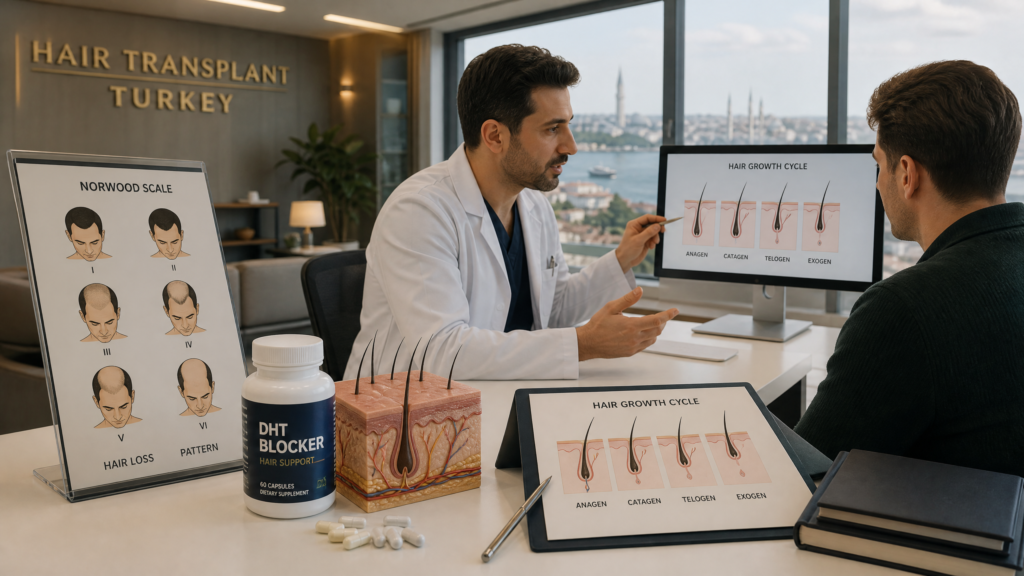
Surgery is often seen as the whole answer to hair loss, but experienced surgeons frequently recommend an important step beforehand, and understanding the role of medication before a hair transplant can make the difference between a result that lasts and one that unravels. Stabilising loss first, under proper medical guidance, protects your existing hair, clarifies the true pattern and helps the surgeon plan a transplant that ages well.
The problem with operating on a moving target
Genetic hair loss is progressive, and operating while it is still actively advancing creates a real risk. If a surgeon transplants into an area while the surrounding native hair is still receding, the patient can end up with transplanted hair that survives while the natural hair around it continues to disappear, leaving gaps or an island effect. Stabilising the loss first reduces this risk, which is why it features so prominently in discussions about candidacy, especially for younger patients.
What stabilisation does
Medications used for pattern hair loss are aimed primarily at slowing further loss and, in some cases, thickening existing miniaturised hairs. They do not regrow a fully bald scalp; that is the job of surgery. The two therefore play complementary roles: medication protects and preserves the hair you still have, while a transplant restores hair to areas that are already bald. Used together under medical supervision, they support a more stable, durable result.
Letting the pattern declare itself
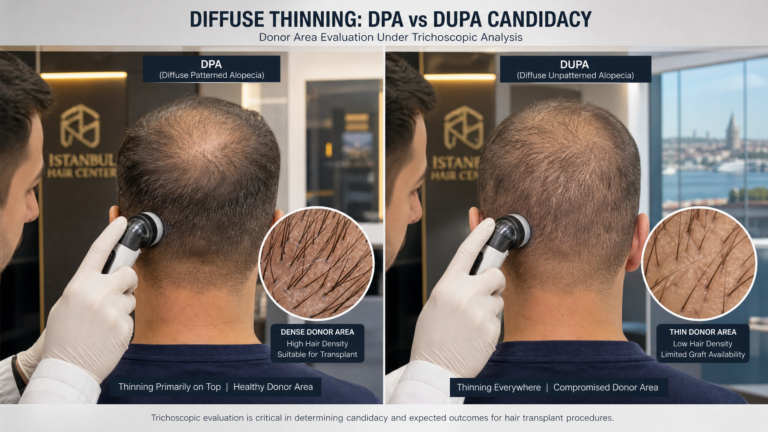
Stabilising loss also gives the surgeon better information. When hair loss is brought under control and observed over time, the true, settled pattern becomes clearer, and the donor area can be assessed more accurately. This is particularly important for distinguishing favourable patterned thinning from the unpatterned kind that affects the donor zone, a distinction explored in our guide to DPA versus DUPA. Better information means better planning and a lower chance of regret.
Protecting your graft budget
There is also a long-term, strategic reason to stabilise. Every graft used is drawn from a finite lifetime graft budget. If medication can slow ongoing loss, it may reduce how much surgery you ultimately need over the years, preserving donor capacity for the future. In this sense, stabilisation is not just about the next procedure but about your whole restoration journey.
A medical decision, not a default
It is essential to be clear that these medications are not suitable for everyone. They carry considerations and potential side effects, and the decision to start or continue them is an individual medical one made with a qualified doctor. This is a recurring theme in our aftercare guides on finasteride and minoxidil: information empowers your conversation with a physician, but it does not replace it.
How Rexalife helps
Rexalife is a medical tourism consultancy connecting patients with verified clinics and surgeons in Turkey; we do not prescribe medication or provide medical advice. We help you reach clinics that take a responsible, long-term view, including recommending stabilisation where appropriate and coordinating with your own doctor. Any decision about medication, before or after surgery, rests entirely with you and your physician.
Coordinating medication with your own doctor
Because medication decisions are medical and personal, the best approach involves your own doctor as well as the surgical clinic. A clinic abroad can advise that stabilisation would benefit your plan, but the prescription, monitoring and management of any medication is properly the domain of a physician who knows your full health history. This is especially important given that these drugs carry considerations and potential side effects that vary between individuals. Coordinating between your local doctor and the clinic ensures that any medication is started, adjusted or stopped safely and with proper oversight. It also means someone is monitoring how you respond over time, which matters for a treatment intended to run for the long term. Rexalife’s role here is purely to connect and coordinate, never to advise on or supply medication; that responsibility sits firmly with qualified doctors. Approaching the medication side of your restoration with this care, rather than treating it as a casual add-on, protects both your health and your result. It is one more example of how the most successful hair restoration journeys are built on proper medical foundations rather than shortcuts.
For most patients, the takeaway is that stabilising loss first, always as a medical decision made with a doctor, builds the stable foundation on which a natural, durable transplant result depends.
Ultimately, the patients who approach stabilisation thoughtfully, in genuine partnership with their own doctor and their chosen clinic, give themselves the best possible foundation for a result that looks natural and lasts for years to come.
You may also want to read about whether an over-harvested donor area can be fixed, since protecting the donor zone is closely tied to stabilising loss and planning conservatively.
Conclusion
Medication before a hair transplant is about building on stable ground. By slowing ongoing loss, protecting existing hair and clarifying the true pattern, stabilisation helps the surgeon plan a result that looks natural and ages well, while preserving your finite donor supply. It is always a medical decision made with a doctor, never a default, but for many patients it is a quietly crucial step toward a restoration they will be glad they took the time to do properly.
Frequently Asked Questions
Why stabilise hair loss before a transplant?
Operating while loss is still actively progressing risks an unnatural result, because native hair can keep receding around the transplanted grafts. Stabilising first with medication, under medical guidance, helps protect existing hair and lets the true pattern settle before surgery.
Does medication regrow hair or just stop loss?
Medications used for pattern hair loss mainly work to slow further loss and can thicken some existing miniaturised hairs, rather than fully regrowing bald areas. Surgery addresses what is already lost, while medication protects what remains.
Will I need to keep taking medication after surgery?
Often yes, if you and your doctor decide it is appropriate, because a transplant does not stop ongoing loss in untreated native hair. Continuing medication can help preserve the surrounding hair, but this is a medical decision.
Is medication suitable for everyone?
No. These medications have considerations and potential side effects, and suitability is an individual medical decision made with a doctor. Rexalife does not prescribe or advise on medication; that is for your physician.
About the author
admin — RexaLife medical content team. All health content is reviewed by qualified professionals.
Have questions about this topic?
Speak with a dedicated coordinator. No obligation — your information stays private.
RexaLife is a medical tourism facilitator and healthcare concierge service. RexaLife is not a hospital, clinic, or medical provider and does not provide medical care, diagnosis, or advice. All treatments are delivered by independent, accredited partner providers. Information on this page is general and does not replace professional medical consultation. Costs are estimates and depend on the chosen provider.