Bariatric Surgery
BMI and Eligibility Criteria for Bariatric Surgery in Turkey
Reviewed by admin · Last updated July 12, 2026
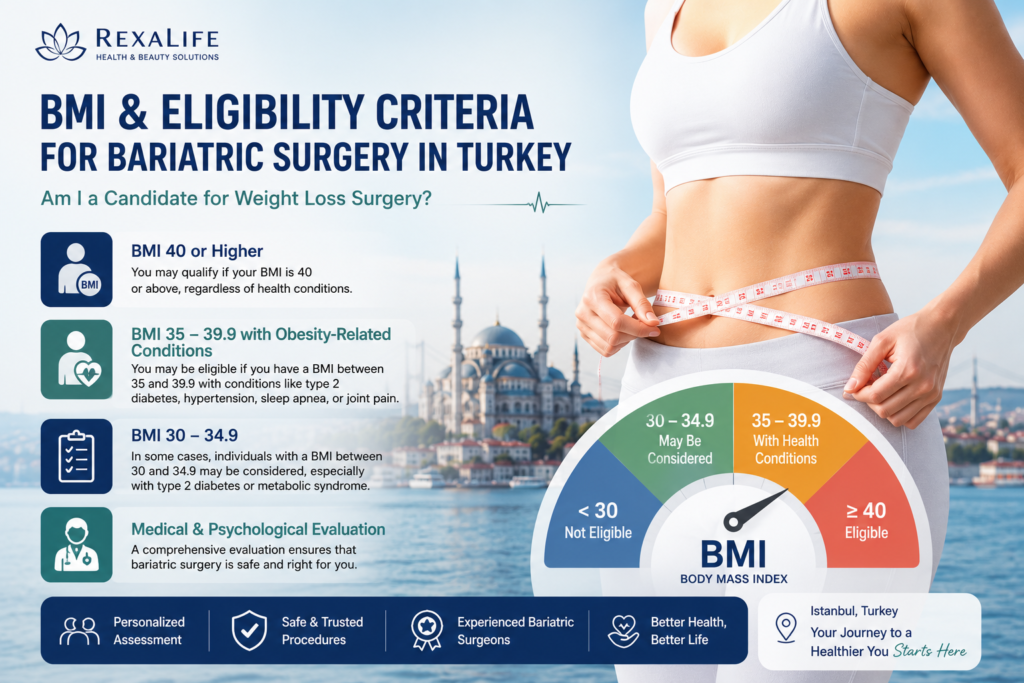
One of the first questions almost every prospective patient asks before booking a consultation is simple: “Do I qualify for bariatric surgery?” The honest answer is that body mass index, or BMI, is only the starting point of a much broader evaluation. This guide explains how BMI thresholds are generally applied in Turkey, what other factors matter just as much, and how the overall eligibility assessment works for international patients.
Rexalife is a medical consultancy, not a hospital or surgical provider. We help match patients with accredited bariatric surgeons in Turkey who can perform a full clinical evaluation — the information here is general guidance to help you prepare for that conversation, not a substitute for it.
Understanding BMI
Body mass index is a simple calculation using height and weight that produces a number used as a general screening tool for obesity-related risk. A BMI between 18.5 and 24.9 is generally considered a healthy weight range, 25 to 29.9 is classified as overweight, and 30 and above is classified as obese, with further subcategories at higher levels. While BMI does not account for muscle mass, body composition, or where fat is distributed in the body, it remains the most widely used starting point internationally for assessing bariatric surgery candidacy because it is simple, consistent, and backed by decades of outcome data linking it to health risk.
Standard BMI Thresholds for Bariatric Surgery
Most surgeons in Turkey, in line with widely accepted international guidelines, consider bariatric surgery for patients with a BMI of 40 or above regardless of other health conditions, or a BMI of 35 to 39.9 combined with at least one significant obesity-related health condition such as type 2 diabetes, high blood pressure, sleep apnea, or severe joint problems linked to excess weight. Some surgeons will also evaluate patients with a BMI as low as 30 to 34.9 specifically for metabolic reasons, particularly where type 2 diabetes is poorly controlled — a nuance we explore in our article on bariatric surgery and type 2 diabetes remission.
It Is Not Just About the Number
BMI thresholds provide a starting framework, but a genuine eligibility assessment goes much further. Surgeons evaluate your overall cardiovascular health, prior abdominal surgeries that might affect the operation, mental health and readiness for the significant lifestyle changes bariatric surgery requires, and your understanding of the lifelong dietary and supplement commitments involved. Patients with active eating disorders, uncontrolled psychiatric conditions, or ongoing substance use are generally asked to address these issues, often with appropriate professional support, before surgery is considered safe and appropriate — because surgery alone cannot resolve underlying behavioral health challenges.
Age Considerations
Most bariatric surgery in Turkey is performed on adults between 18 and 65, though this is a general guideline rather than an absolute rule. Surgeons will look more closely at overall cardiovascular fitness in older patients, and younger patients under 18 are evaluated with considerably more caution and usually only for severe, medically urgent cases with input from pediatric specialists. Patients over 65 are not automatically excluded but typically require a more detailed cardiac and anesthesia risk assessment given the higher likelihood of other health conditions at that age.
Choosing Between Procedures Once You Qualify
Meeting the BMI and health criteria for bariatric surgery is the first step, not the final decision — the next question is which procedure fits your specific situation. Someone with a BMI of 45 and significant reflux may be steered toward a different operation than someone with a BMI of 33 and well-controlled diabetes. Our comparisons of gastric bypass vs gastric sleeve and gastric sleeve vs gastric balloon are useful starting points, but the final recommendation should always come from your surgeon after reviewing your full medical history and any relevant imaging or blood work.
What the Pre-Operative Evaluation Actually Involves
Before surgery is confirmed, most hospitals in Turkey require a set of standard tests: blood work covering blood count, liver and kidney function, blood sugar and cholesterol, an ECG, and often an upper endoscopy to examine the stomach lining. Depending on individual risk factors, additional tests such as a sleep study for suspected sleep apnea or a cardiology review may also be requested. Reviewing our overview of who is a good candidate for gastric sleeve gives a sense of how this evaluation typically unfolds for one of the most commonly performed procedures.
What If You Don’t Meet the Standard Criteria?
Patients who fall just below the usual BMI thresholds are not automatically ruled out, particularly if they have significant obesity-related health conditions. Conversely, patients well above the threshold are not automatically approved either — overall surgical risk still needs to be manageable. This is why a genuine remote consultation with a bariatric surgeon, rather than a generic online quiz, is the only reliable way to know where you personally stand. Rexalife can help arrange this consultation before you commit to any travel plans, so you have clarity before booking flights or paying a deposit.
Preparing Documentation Before Your Consultation
Arriving at your remote consultation with organized documentation speeds up the eligibility assessment considerably. This typically includes your recent weight history, any existing diagnoses such as diabetes or high blood pressure with recent blood work if available, a list of current medications, and details of any previous weight-loss attempts, whether through diet programs, medication, or prior surgery. Surgeons in Turkey are accustomed to reviewing records from other countries and healthcare systems, but having this information organized and translated where necessary makes the initial assessment faster and more accurate.
How Eligibility Criteria Continue to Evolve
Clinical guidelines around bariatric surgery eligibility are not static — professional societies periodically revisit BMI thresholds and criteria as evidence accumulates, particularly around the metabolic benefits of surgery for patients with diabetes at lower BMI levels. This means a surgeon’s assessment today may differ somewhat from guidance published several years ago, which is one more reason a current, direct consultation with a practicing surgeon is more reliable than relying on older articles or general online information when determining your own eligibility.
What to Do If You’re Told You’re Not Yet a Candidate
If an initial consultation determines you don’t currently meet eligibility criteria, this isn’t necessarily a permanent answer. A surgeon may recommend a period of medically supervised weight management, treatment of a specific health condition, or addressing a psychological readiness concern, after which candidacy can be reassessed. Treating this as a structured next step, with clear criteria to work toward, tends to be far more productive than viewing it as a closed door.
Quick Reference: General Eligibility Ranges
- BMI 40+ — generally eligible regardless of other conditions
- BMI 35–39.9 — eligible with an obesity-related health condition
- BMI 30–34.9 — evaluated case by case, often for diabetes management
- Below 30 — not typically considered for bariatric surgery
Ultimately, eligibility is a clinical judgment made jointly between you and your surgical team, informed by these general ranges but never limited strictly to them. Bringing an open, honest account of your health history to that first conversation is the best way to get an accurate answer specific to you.
How Rexalife Helps
We connect prospective patients with bariatric surgeons in Turkey for an honest remote evaluation of eligibility based on your actual health history, not just a BMI calculator. If surgery is appropriate, we help you compare accredited hospitals, obtain transparent quotes, and prepare the documentation your surgical team will need before you travel. If surgery is not the right fit for you at this stage, a good consultancy will tell you that too, rather than pushing you toward a procedure that isn’t appropriate.
Frequently Asked Questions
What BMI do I need to qualify for bariatric surgery in Turkey?
Most surgeons consider surgery for a BMI of 40 or above, or 35 to 39.9 with an obesity-related condition like diabetes or high blood pressure. Some surgeons also evaluate patients with a BMI as low as 30 to 34.9 for metabolic reasons.
Is BMI the only factor surgeons consider for eligibility?
No. Surgeons also assess cardiovascular health, prior surgeries, mental health readiness, and your understanding of the lifelong dietary changes bariatric surgery requires.
Can I get bariatric surgery if I’m over 65?
It’s not automatically excluded, but patients over 65 typically need a more detailed cardiac and anesthesia risk assessment before surgery is approved.
What tests are required before bariatric surgery in Turkey?
Standard pre-operative testing usually includes blood work, an ECG, and an upper endoscopy, with additional tests like a sleep study or cardiology review added depending on individual risk factors.
What if my BMI is just below the usual threshold?
You may still be considered, especially with significant obesity-related health conditions. A remote consultation with a bariatric surgeon is the only reliable way to determine your individual eligibility.
Can I have bariatric surgery for cosmetic weight loss with a low BMI?
No, bariatric surgery is a medical procedure reserved for patients meeting specific clinical thresholds; it is not offered as a cosmetic option for modest weight loss goals in patients without significant obesity-related health risk.
Do surgeons in Turkey follow international eligibility guidelines?
Yes, most reputable surgeons in Turkey follow widely accepted international guidelines for BMI and health-condition thresholds, adapted with individual clinical judgment for each patient’s specific case.
About the author
admin — RexaLife medical content team. All health content is reviewed by qualified professionals.
Have questions about this topic?
Speak with a dedicated coordinator. No obligation — your information stays private.
RexaLife is a medical tourism facilitator and healthcare concierge service. RexaLife is not a hospital, clinic, or medical provider and does not provide medical care, diagnosis, or advice. All treatments are delivered by independent, accredited partner providers. Information on this page is general and does not replace professional medical consultation. Costs are estimates and depend on the chosen provider.