Hair Transplant
Hair Transplant Density: What Is Realistic?
Reviewed by admin · Last updated June 22, 2026
When patients imagine the result of a hair transplant, they often picture the thick hair of their youth. This is why hair transplant density is one of the most important, and most misunderstood, topics in restoration. Density matters enormously to how full and natural a result looks, but more is not always better, and the supply is finite. Understanding what density is realistically achievable, and why natural-looking density is a wiser goal than maximum density, helps patients set expectations that lead to genuine satisfaction.
What density actually means
Density refers to how many hairs occupy a given area of scalp. Naturally, unaffected hair has a high density that creates full coverage, and the appearance of fullness depends not only on the number of hairs but also on their thickness and characteristics. A transplant redistributes follicles from the donor area to thinning regions, but it cannot create new hair from nothing; it can only move the finite supply you have. This means the achievable density is fundamentally limited by your donor resources, which is the key fact shaping realistic expectations.
Why maximum density is the wrong goal
It is tempting to want the densest possible result, but chasing maximum density carries real risks. Packing grafts too tightly can compromise their blood supply and survival, and demanding very high density over a large area can deplete the donor supply, leaving nothing for the future and potentially thinning the donor region itself. There is also an aesthetic risk: an unnaturally dense patch can look artificial, especially as surrounding native hair thins with age. For these reasons, experienced surgeons aim for density that looks natural and ages gracefully, not the maximum the donor area could theoretically yield. Our guide on donor area management explains why this restraint protects you.
What influences achievable density
Several factors determine how much density is realistic for you. Your donor supply is the foundation: a generous, healthy donor area allows more than a limited one. The size of the area to be covered matters, since the same supply spread over a larger region yields lower density. Your hair characteristics play a big role too: thicker and curlier hair provides more visual coverage per follicle, so it can look denser with fewer grafts than fine, straight hair, as our guide on afro and curly hair describes. The need to plan for ongoing loss also shapes how density is distributed.
Natural density as the real aim
The most satisfying results are those that look natural rather than maximally dense. A skilled surgeon designs density to mimic how hair naturally grows, often slightly less dense at the very front hairline and building behind it, and distributes the available supply to create the impression of fullness across the whole area. This artistry, balancing density against naturalness and the finite donor supply, is what distinguishes excellent work. The goal is a result that looks like your own healthy hair, blends with your features, and continues to look appropriate as you age, not a dense patch that draws the eye for the wrong reasons.
Setting expectations with your surgeon
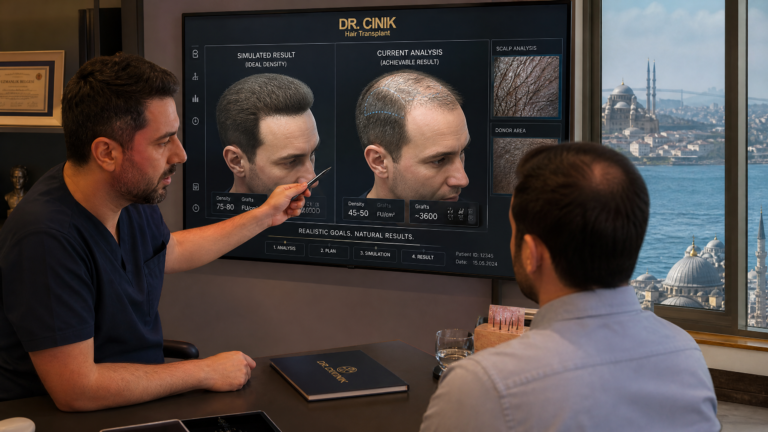
Because density is so individual, the right expectations come from an honest conversation with your surgeon. They assess your donor supply, the area to be covered and your hair type, then explain what density is realistically achievable and how they plan to distribute it. Reviewing realistic before-and-after examples in cases similar to yours is invaluable, as it shows what natural density actually looks like rather than an idealised image. A surgeon who talks candidly about the limits of density, and designs for a natural, lasting result, is showing exactly the judgement you want, as our guide on realistic before-and-after results illustrates.
How Rexalife Helps
Rexalife is a medical tourism consultancy that connects international patients with verified clinics and surgeons in Turkey. We do not perform procedures or give medical advice. Our role is to help you find reputable clinics that design for natural, lasting results, understand what density is realistic for your case, and coordinate consultations and logistics. All decisions about density and design rest with your surgeon after assessment. Patients setting expectations may also find our guide on how many grafts you need helpful.
Why honest expectations lead to happier outcomes
There is a strong link between realistic expectations about density and long-term satisfaction. Patients who go in expecting the impossibly thick hair of their teens can feel disappointed even by an objectively excellent result, while those who understand what natural density looks like tend to be delighted by the same outcome. This is why an honest surgeon who manages expectations carefully is doing you a genuine service, even when the conversation is less exciting than a promise of maximum density. Looking at realistic before-and-after examples, understanding how your donor supply and hair type shape what is achievable, and appreciating that natural density ages better than a dense patch all help align your hopes with reality. The most successful restorations, in terms of how patients feel about them years later, are those where expectations and results were matched from the start. Choosing a surgeon who prioritises this honesty is one of the surest routes to being genuinely happy with your hair.
Realistic density also connects to wider choices, including regenerative options such as exosome therapy versus PRP, specialised scar repair, and weighing an unshaven against a shaven approach.
Conclusion
Hair transplant density is central to a natural-looking result, but the goal should be natural density rather than maximum density, because the donor supply is finite and over-packing risks both survival and a false appearance. Achievable density depends on your donor resources, the area to cover and your hair type. Aim for a result that looks like your own healthy hair and ages well, and trust an honest surgeon to design density that lasts.
Frequently Asked Questions
How much density can a hair transplant achieve?
A transplant can restore natural-looking density, but it usually cannot match the full density of unaffected youthful hair, because the donor supply is finite. The goal is a natural, balanced appearance rather than maximum density, which your surgeon plans around your donor resources and goals.
Why isn’t maximum density the goal?
Chasing maximum density can deplete the donor area and risk an unnatural look, and the donor supply is limited. Experienced surgeons aim for density that looks natural and ages well, preserving donor reserves for the future, which serves patients far better long term.
What affects achievable density?
Key factors include your donor supply, the size of the area to cover, your hair characteristics such as thickness and curl, and the need to plan for ongoing hair loss. These are assessed individually rather than promised as a fixed figure.
Can curly hair look denser?
Yes, curly and thicker hair provides more visual coverage and can appear denser with fewer grafts than fine, straight hair. Your surgeon factors your hair type into the density plan.
About the author
admin — RexaLife medical content team. All health content is reviewed by qualified professionals.
Have questions about this topic?
Speak with a dedicated coordinator. No obligation — your information stays private.
RexaLife is a medical tourism facilitator and healthcare concierge service. RexaLife is not a hospital, clinic, or medical provider and does not provide medical care, diagnosis, or advice. All treatments are delivered by independent, accredited partner providers. Information on this page is general and does not replace professional medical consultation. Costs are estimates and depend on the chosen provider.