Hair Transplant
Norwood 7 Hair Transplant: Is It Even Possible?
Reviewed by admin · Last updated June 22, 2026
Severe baldness prompts one very direct question, and a Norwood 7 hair transplant is among the most honest searches a man can make: is restoration even possible when almost all the hair on top is gone? The answer for many patients is a qualified yes, but Norwood 7 sits at the very edge of what surgery can address, and understanding the limits is just as important as understanding the possibilities.
Understanding Norwood 7
Norwood 7 is the most advanced stage on the Norwood scale. The entire top of the scalp, including the front, mid-scalp and crown, is bald, and only a narrow horseshoe band of hair remains around the back and sides. Critically, at this stage even the donor zone itself can be lower and thinner than in earlier stages, which shrinks the very resource a transplant depends on. This combination of maximum demand and minimum supply is what makes Norwood 7 the hardest pattern to treat.
The donor area is everything
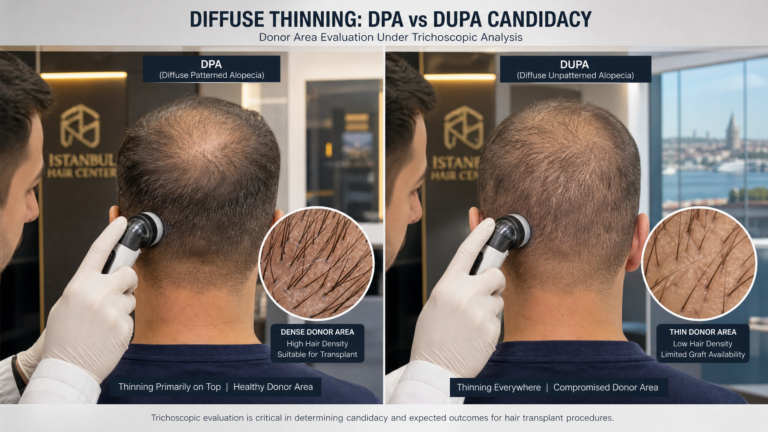
For any candidate, but especially at this stage, the donor area determines what is achievable. A surgeon measures donor density and hair calibre to estimate how many grafts can be safely harvested without leaving the back of the head visibly depleted. Some Norwood 7 patients retain a surprisingly robust horseshoe and remain reasonable candidates, while others simply do not have enough permanent hair for meaningful coverage. This is why an honest, individual assessment matters far more than any generic promise, and why learning how overharvesting is avoided is part of responsible planning.
What coverage is realistic
The most important shift in thinking for a Norwood 7 patient is to abandon the idea of full, youthful density. The bald area is simply too large and the donor supply too limited for that. Instead, the realistic and genuinely valuable goal is a natural frontal hairline and forelock that reframe the face. A defined, conservative hairline can transform appearance and confidence even when the crown and mid-scalp remain lighter or are left untreated. Many surgeons favour a high, age-appropriate hairline that uses grafts efficiently and looks natural for decades.
The frontal forelock strategy
When donor supply is very limited, concentrating grafts into a defined central frontal zone, sometimes called a forelock, is a recognised and dignified strategy. Rather than spreading a small number of grafts uselessly thin across a vast scalp, the surgeon builds a strong, natural frame at the front where it has the most impact. This focused approach often produces a more satisfying result than an attempt at thin overall coverage that ends up looking see-through. You can read more about this forelock strategy for limited donor hair.
When other options make more sense
Honesty cuts both ways. For some Norwood 7 patients, the donor area is too sparse to justify extensive surgery, and a good surgeon will say so. In these cases, options such as scalp micropigmentation, which creates the look of a closely shaved head, or a combination approach, may serve the patient better than a transplant that overpromises. A clinic willing to turn you away or recommend an alternative is often demonstrating exactly the integrity you want.
How Rexalife helps
Rexalife is a consultancy that connects patients with verified clinics and surgeons in Turkey; we do not operate or provide medical advice. For a complex Norwood 7 case, we help you reach surgeons who assess donor supply honestly and explain realistic outcomes rather than selling an impossible result. If surgery is not the right answer for you, an experienced clinic can discuss alternatives, and the final clinical judgement always rests with the treating doctor.
The psychology of advanced loss
It is worth acknowledging the emotional dimension of severe baldness, because it shapes how patients approach surgery. Years of extensive loss can build an understandable longing for a dramatic transformation, and that longing can collide with the biological limits of a finite donor area. The most satisfied Norwood 7 patients are usually those who reframe success not as the return of youthful hair but as a natural, balanced improvement that restores a sense of self. A defined frontal frame, even a high and conservative one, can change how a man feels far more than the raw graft count would suggest. Approaching the process this way, with patience and realism, protects against the disappointment that comes from chasing an impossible ideal. A good surgeon spends as much time managing expectations as planning grafts, and that conversation is part of the value of an honest consultation. Reading widely beforehand, including our guide to setting realistic expectations, helps you arrive at that consultation ready to hear the truth and make a decision you will be content with for the long term.
For more on planning around your hair type, see our guide to ethnicity and donor density differences, which explains how hair characteristics shape what coverage is achievable.
Conclusion
A Norwood 7 hair transplant is possible for some patients and unwise for others, and the difference comes down to the donor area and realistic expectations. The achievable goal is usually a natural frontal frame rather than full restoration, and a frontal forelock strategy often makes the best use of limited supply. Above all, seek a surgeon who will tell you the truth about what your scalp can support, because at this stage honesty is the most valuable thing a clinic can offer.
Frequently Asked Questions
Can a Norwood 7 patient have a hair transplant?
Many Norwood 7 patients can have surgery, but the donor area is the deciding factor and not everyone has enough permanent hair for meaningful coverage. A thorough assessment of donor density and quality determines whether surgery is realistic and what it can achieve.
Can a Norwood 7 scalp be made fully dense?
Full, youthful density across an entire Norwood 7 scalp is generally not achievable because the bald area is at its largest and the donor supply at its most limited. The realistic aim is a natural frontal frame and partial coverage rather than complete restoration.
What if my donor area is too thin?
When donor density is insufficient, a surgeon may advise against extensive surgery and discuss alternatives such as scalp micropigmentation or a conservative frontal-only plan. Proceeding with inadequate donor supply risks an unnatural result and a depleted donor zone.
Is body hair ever used for Norwood 7?
In selected cases, body or beard hair may supplement scalp donor supply, but it behaves differently and is not a like-for-like replacement. Whether it is suitable is a clinical judgement made during assessment.
About the author
admin — RexaLife medical content team. All health content is reviewed by qualified professionals.
Have questions about this topic?
Speak with a dedicated coordinator. No obligation — your information stays private.
RexaLife is a medical tourism facilitator and healthcare concierge service. RexaLife is not a hospital, clinic, or medical provider and does not provide medical care, diagnosis, or advice. All treatments are delivered by independent, accredited partner providers. Information on this page is general and does not replace professional medical consultation. Costs are estimates and depend on the chosen provider.