Hair Transplant
Scalp Micropigmentation vs Hair Transplant: Which Is Right for You?
Reviewed by admin · Last updated June 22, 2026
When you start researching hair loss solutions, two very different procedures dominate the conversation, and the scalp micropigmentation vs hair transplant question is one of the most useful to understand early. They are often presented as rivals, but they solve the problem in fundamentally different ways, and the right choice depends entirely on your hair loss, your goals and your lifestyle rather than on which one is universally better.
Two completely different approaches
A hair transplant is a surgical procedure that moves permanent, DHT-resistant follicles from the donor area to thinning or bald regions, where they grow real hair for life. Scalp micropigmentation, or SMP, is a non-surgical cosmetic procedure in which fine needles deposit pigment into the scalp to replicate the look of tiny hair follicles. The crucial distinction is simple: a transplant restores actual growing hair, while SMP creates a visual illusion of density. One is biological, the other cosmetic.
Results and what they feel like
With a transplant you get real hair you can grow, cut and style, and the result develops gradually over roughly a year as the follicles cycle and grow. With SMP the result is immediate after the sessions, but it is a surface appearance: it works beautifully for a closely shaved or buzz-cut style and for adding the look of density between existing hairs, yet it does not produce hair you can run your fingers through. Your preference between real regrowth and an instant cosmetic finish is one of the biggest deciding factors.
Cost over time
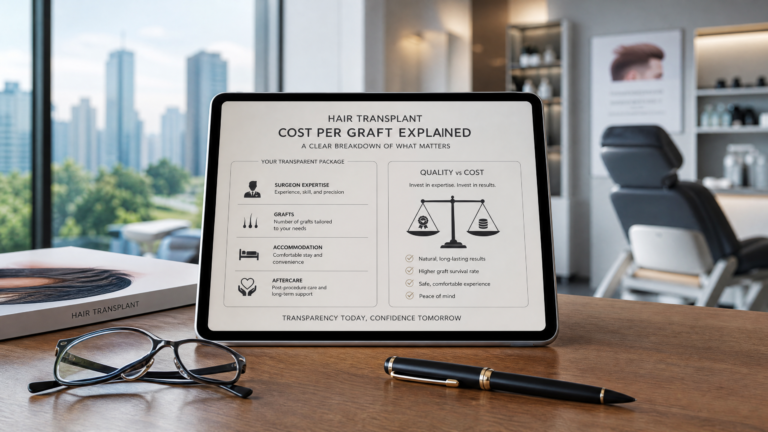
SMP usually has a lower upfront cost because it avoids surgery, but pigment fades gradually and touch-ups are needed every few years. A transplant carries a higher initial cost, explored in our guide to cost per graft, but the transplanted hair is permanent. Rather than asking simply which is cheaper, it is more useful to think about the total cost over a decade and what each delivers for that spend.
Candidacy: who suits which
Candidacy often decides the matter. A transplant requires a healthy donor area, so patients with very advanced loss and a depleted donor zone may not be good surgical candidates. SMP, by contrast, works even for complete baldness because it does not depend on donor hair. If you have a strong donor area and want real hair, a transplant makes sense; if your donor supply is limited or you prefer a shaved aesthetic with no surgery, SMP may suit you better. Understanding who is not a good transplant candidate often points the way.
The hybrid approach
Increasingly, the smartest answer is not either-or but both. For advanced loss, a common strategy is to transplant the frontal hairline and mid-scalp for real, face-framing hair, then use SMP to add the appearance of density in the crown, where graft demand is highest and visual return lowest. SMP is also widely used to camouflage donor scars and to make transplanted hair look fuller. This hybrid logic usually requires waiting until the transplant has fully matured, and is covered in our guide to SMP after a hair transplant.
Making the decision
Ask yourself a few honest questions. Do you want real growing hair or are you comfortable with a shaved-style illusion of density? How advanced is your loss, and how strong is your donor area? Are you willing to undergo surgery and wait months for results, or do you want an immediate finish? There is no universally correct answer, only the one that fits you, which is why an unbiased consultation matters so much.
How Rexalife helps
Rexalife is a medical tourism consultancy connecting patients with verified clinics and surgeons in Turkey; we do not perform procedures or give medical advice. Because clinics that offer only one of these treatments naturally favour it, we help you reach providers who can discuss transplant, SMP and hybrid options honestly. The right choice is always a clinical and personal decision made with your treating professional.
Beware of single-offering bias
One practical challenge in researching this decision is that most advice comes from clinics offering only one of the two treatments, and that naturally colours their recommendation. An SMP-only studio tends to present pigmentation as the superior choice for almost everyone, while a transplant-only clinic may frame SMP as merely a secondary or corrective option. Neither perspective is wrong exactly, but both are shaped by what the provider sells. The most useful guidance comes from a source with no stake in steering you one way, ideally a clinician or consultant who can discuss transplant, SMP and the hybrid approach on their genuine merits for your specific case. When reading comparisons online, it is worth asking what the author actually offers, because that often explains the conclusion. The right choice depends on your hair loss stage, donor area, budget, lifestyle and tolerance for surgery, not on which procedure a particular business happens to specialise in. Keeping this bias in mind as you research helps you weigh the trade-offs honestly and arrive at a decision driven by your own needs rather than by someone else’s commercial interest.
For related decisions, see our guides on temple point restoration and on repair work to fix a disappointing result, where the choice between approaches also comes into play.
Conclusion
The scalp micropigmentation vs hair transplant decision is not about which procedure wins but about which fits your hair loss, donor area, budget and lifestyle. A transplant gives real hair, SMP gives an instant cosmetic illusion, and for many patients with advanced loss the two combine into a result neither could achieve alone. Get an honest, unbiased assessment, weigh the trade-offs against your own goals, and you will choose the path that genuinely suits you.
Frequently Asked Questions
What is the main difference between SMP and a hair transplant?
A hair transplant relocates real, growing follicles to restore actual hair, while scalp micropigmentation deposits pigment into the scalp to create the visual illusion of density or a closely shaved look. One grows hair; the other mimics its appearance.
Is SMP cheaper than a hair transplant?
SMP is usually lower in upfront cost because it is non-surgical, though it needs periodic touch-ups over the years. A transplant costs more initially but produces real hair you can grow and style, so the right value comparison depends on your goals.
Can SMP and a hair transplant be combined?
Yes, and for advanced loss this hybrid approach is increasingly common, such as transplanting the frontal hairline and using SMP to add the look of density to the crown. Combining them usually requires waiting until the transplant has fully matured.
Which one looks more natural?
Both can look very natural in skilled hands, but they achieve different things. A transplant gives real three-dimensional hair you can run your fingers through, while SMP gives a convincing shaved or denser appearance without growing hair.
About the author
admin — RexaLife medical content team. All health content is reviewed by qualified professionals.
Have questions about this topic?
Speak with a dedicated coordinator. No obligation — your information stays private.
RexaLife is a medical tourism facilitator and healthcare concierge service. RexaLife is not a hospital, clinic, or medical provider and does not provide medical care, diagnosis, or advice. All treatments are delivered by independent, accredited partner providers. Information on this page is general and does not replace professional medical consultation. Costs are estimates and depend on the chosen provider.