Bariatric Surgery
Revisional Bariatric Surgery: When You Need a Second Weight-Loss Procedure
Reviewed by admin · Last updated July 12, 2026
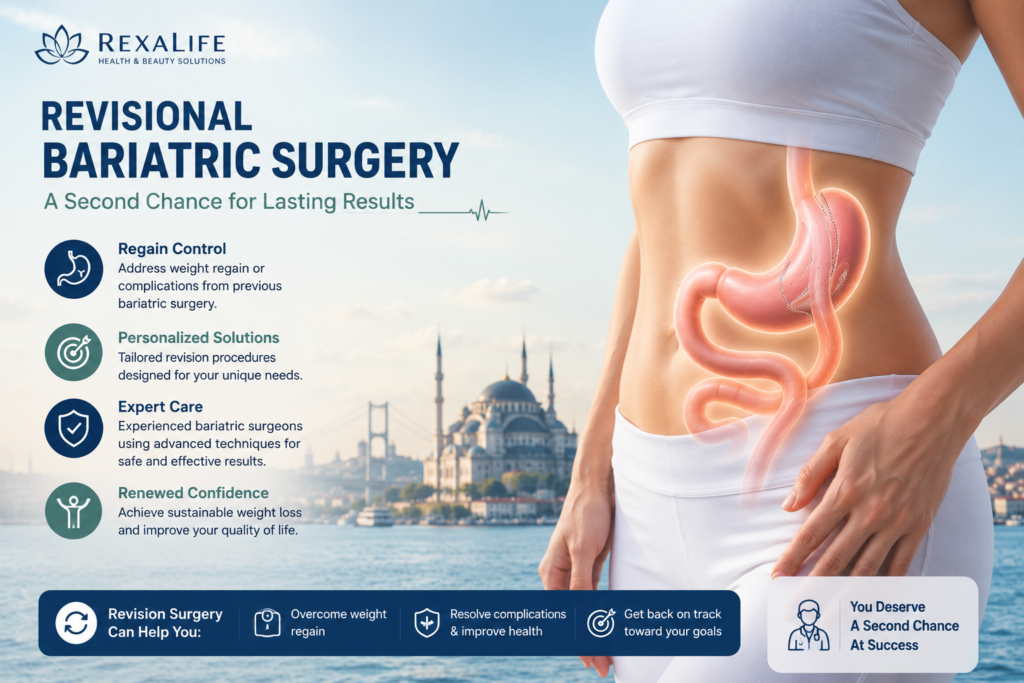
Not every weight-loss journey follows a straight line after bariatric surgery, and that is more common than most patients expect. Revisional bariatric surgery refers to any second procedure performed to correct, adjust, or convert a previous weight-loss operation — whether because of insufficient weight loss, weight regain, or a medical complication such as severe reflux. Turkey has become a major destination for revisional surgery precisely because it has a high concentration of surgeons who perform these more technically demanding operations regularly.
Rexalife is a healthcare consultancy, not a surgical provider. We help international patients who need a revision procedure connect with bariatric surgeons who specialize specifically in revisional cases, since not every bariatric surgeon has deep experience with this more complex category of surgery.
Why Do First Bariatric Procedures Sometimes Need Revision?
There are several common reasons a patient might need a second procedure. Some patients experience gradual weight regain years after their original surgery as the stomach pouch stretches over time or eating habits drift. Others did not lose as much weight as expected in the first place, a situation sometimes linked to the original procedure type or to anatomical factors. A smaller group develop complications such as severe acid reflux after a gastric sleeve, or a stretched gastric pouch after a gastric bypass, which can require correction independent of weight-loss goals. Understanding whether weight can return after bariatric surgery and why is a helpful starting point before considering revision.
Common Types of Revisional Surgery
The right revisional option depends heavily on which procedure you had originally. Patients who had a gastric sleeve and experience weight regain or reflux are often converted to a gastric bypass or mini gastric bypass, since rerouting the digestive tract can resolve reflux while restarting weight loss — see our detailed guide to mini gastric bypass in Turkey for how that procedure works. Patients who had an older gastric banding procedure frequently have the band removed and replaced with a sleeve or bypass, since bands have fallen out of favor due to long-term complication rates. Patients who had a gastric bypass and experience a stretched pouch may undergo a pouch resizing procedure, sometimes combined with an endoscopic technique rather than full open or laparoscopic surgery.
Is Revisional Surgery Riskier Than the First Operation?
Generally, yes — revisional bariatric surgery carries a higher complication rate than a first-time procedure, mainly because scar tissue from the original surgery makes the anatomy more complex to work with. This is precisely why surgeon experience matters more here than in almost any other area of bariatric care. A surgeon who performs revisional cases regularly will have strategies for managing scar tissue, adhesions, and altered anatomy that a general bariatric surgeon may not encounter often. Our broader overview of bariatric surgery risks applies here too, but revision cases warrant an extra-thorough conversation with your surgeon about their specific experience with revisions.
The Evaluation Process
Before any revision is recommended, a proper evaluation usually includes imaging of the stomach and digestive tract, an endoscopy to assess the anatomy, and a detailed review of eating habits and lifestyle since the first surgery. This step matters because not every case of weight regain requires another operation — sometimes structured dietary support, behavioral coaching, or medication can achieve the goal without further surgery. A responsible surgeon and consultancy will explore non-surgical options first and only recommend revision when it is genuinely the most appropriate path forward.
Cost Considerations
Revisional bariatric surgery is generally more expensive than a first-time procedure because operating time is longer and the surgical team’s expertise commands a premium. Even so, prices in Turkey typically remain well below equivalent revision surgery costs in the UK, US, or Western Europe. Because every revision case is different, an accurate quote requires the surgeon to review your original operative report and current imaging, which Rexalife can help coordinate remotely before you commit to travel. Our Medical Tourism Turkey Cost Guide 2026 gives a general sense of price ranges, though revision cases should always be quoted individually.
Recovery After Revisional Surgery
Recovery timelines after revisional surgery are often somewhat longer than after a first-time procedure, both because of the increased surgical complexity and because the body has already adapted once to a changed digestive anatomy. Most patients stay in hospital two to four days and remain in Turkey for roughly two weeks for monitoring, similar to guidance in our article on how long you should stay in Turkey after bariatric surgery. A staged return to solid foods, close attention to hydration, and ongoing vitamin supplementation remain essential regardless of which revision procedure is performed.
Bringing Your Full Medical History
The single most valuable thing a patient can do before a revision consultation is gather every piece of documentation from the original surgery: the operative report, any post-operative imaging, endoscopy results, and a clear timeline of weight changes since the procedure. Surgeons in Turkey routinely work with international patients and are accustomed to reviewing records from other countries, but complete documentation dramatically improves the accuracy of any surgical plan proposed before you travel.
Insurance and Documentation for Revision Cases
International patients seeking revision surgery should be aware that home-country insurance, where it applies to bariatric procedures at all, is often more restrictive about covering revisional surgery than a first-time procedure, since insurers frequently require documented evidence that non-surgical options have already been tried. Even where insurance isn’t a factor, keeping a clear paper trail — your original consent forms, discharge summary, and any correspondence with your first surgical team — makes the evaluation in Turkey faster and more accurate, and can also matter if you ever need to explain your surgical history to a new doctor at home in the future.
Setting Realistic Expectations for a Second Procedure
Patients approaching revision surgery sometimes hope for the same dramatic early weight loss curve they experienced after their first operation, but revision cases often show a more gradual response, particularly in patients converting from one restrictive procedure to another. A frank conversation with your surgeon about realistic expectations for your specific revision type, based on your original procedure and current health, helps set a mindset that supports long-term success rather than measuring progress against your first surgery’s timeline.
Emotional Aspects of Needing a Second Surgery
Beyond the physical and logistical planning, many patients feel a sense of disappointment or even failure at needing a second procedure, particularly if they worked hard to maintain results after their first surgery. It’s worth recognizing that weight regain and the need for revision are common, well-documented outcomes for a meaningful proportion of bariatric patients, not a personal failing, and that surgeons experienced in revision cases understand this and approach the conversation with the same clinical seriousness as any other bariatric consultation.
A Quick Pre-Consultation Checklist
- Original operative report and surgeon’s notes
- Recent imaging or endoscopy results, if available
- A timeline of weight changes since your first surgery
- A list of any non-surgical approaches already tried
- Current medications and relevant blood work
How Rexalife Helps
We connect patients considering revisional surgery with surgeons who have specific, verifiable experience in revision cases, help gather and translate your original medical records where needed, and obtain a clear, itemized quote based on your actual case rather than a generic price list. We stay involved through your recovery and help arrange remote follow-up so your long-term outcome — not just the operation itself — stays the focus.
Frequently Asked Questions
How do I know if I need revisional bariatric surgery?
Signs include significant weight regain, insufficient weight loss from the start, or new symptoms like severe acid reflux after a gastric sleeve. A proper evaluation with imaging and endoscopy is needed to confirm whether revision surgery is the right option.
Is revisional bariatric surgery more expensive than the first procedure?
Yes, revision procedures typically cost more due to longer operating times and increased surgical complexity, though prices in Turkey remain significantly lower than equivalent revision surgery in the UK, US, or Western Europe.
What is the most common type of bariatric revision?
Converting a gastric sleeve to a gastric bypass or mini gastric bypass is one of the most common revisions, often performed to address weight regain or reflux symptoms.
Is revisional surgery riskier than a first-time bariatric procedure?
It generally carries a higher complication rate due to scar tissue and altered anatomy from the original surgery, which is why choosing a surgeon experienced specifically in revision cases is important.
Do I need to bring my original medical records for a revision consultation?
Yes. Your operative report, post-operative imaging, and endoscopy results from the original surgery help the surgeon plan an accurate, safe approach before you travel.
Can I get revisional surgery if my first procedure was done in a different country?
Yes, surgeons in Turkey routinely evaluate patients whose original surgery was performed elsewhere, provided you can supply your operative report and relevant imaging or test results from that procedure.
Will insurance cover revisional bariatric surgery?
Coverage varies widely and is often more restrictive for revision procedures than first-time surgery, so it’s worth checking directly with your insurer and keeping thorough documentation of your original treatment and any non-surgical attempts made since.
About the author
admin — RexaLife medical content team. All health content is reviewed by qualified professionals.
Have questions about this topic?
Speak with a dedicated coordinator. No obligation — your information stays private.
RexaLife is a medical tourism facilitator and healthcare concierge service. RexaLife is not a hospital, clinic, or medical provider and does not provide medical care, diagnosis, or advice. All treatments are delivered by independent, accredited partner providers. Information on this page is general and does not replace professional medical consultation. Costs are estimates and depend on the chosen provider.