
Diagnostics & Check-Ups
Fibroscan Liver Testing in Turkey: A Non-Invasive Alternative to Liver Biopsy
Reviewed by admin · Last updated July 14, 2026
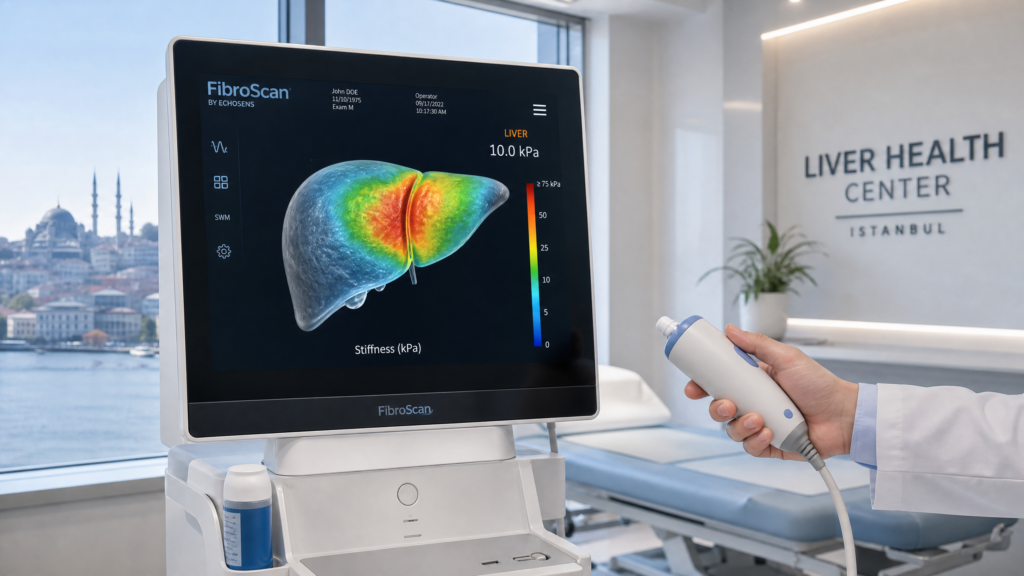
- For decades, a liver biopsy — a needle procedure to remove a small tissue sample for analysis — was the only reliable way to assess the extent of liver scarring, known as fibrosis. Fibroscan, a specialized form of ultrasound-based liver elastography, has changed that, offering a painless, non-invasive way to estimate liver stiffness and fat content in a few minutes. Several diagnostic centers in Turkey now offer Fibroscan as part of comprehensive health screening packages, particularly for patients with risk factors for fatty liver disease. This guide explains how the test works and who should consider it.
Rexalife is a medical consultancy. We help arrange Fibroscan testing at accredited diagnostic centers in Turkey and connect you with a hepatologist or gastroenterologist to interpret results appropriately. We do not perform testing or provide diagnoses ourselves.
What Does Fibroscan Actually Measure?
Fibroscan uses a specialized ultrasound probe that sends a mild vibration through the liver and measures how quickly the resulting elastic wave travels through the tissue. Stiffer, more scarred liver tissue transmits this wave faster than healthy, elastic tissue, allowing the machine to calculate a liver stiffness measurement that correlates closely with the degree of fibrosis present. Many modern Fibroscan machines also measure a separate parameter reflecting the amount of fat within the liver, making the test useful for assessing both fibrosis and fatty liver disease in a single session.
Why Fibroscan Matters for Fatty Liver Disease
Non-alcoholic fatty liver disease has become remarkably common worldwide, closely linked to obesity, type 2 diabetes, and metabolic syndrome, and in many cases it produces no noticeable symptoms until it has progressed significantly. Because Fibroscan can detect early fibrosis before it becomes advanced, it has become a valuable screening tool for patients with risk factors — even those who feel entirely well — allowing earlier lifestyle intervention before serious liver damage develops. This makes it a natural addition to broader metabolic health screening, alongside tests discussed in our guide to preventive health tests that can save your life.
How Fibroscan Compares to Liver Biopsy
A traditional liver biopsy remains the most direct way to examine liver tissue under a microscope and can provide certain detailed information that Fibroscan cannot, such as the specific type of liver inflammation present. However, biopsy is an invasive procedure carrying a small risk of bleeding, pain, and rare but serious complications, along with the discomfort of a needle inserted through the abdominal wall into the liver. Fibroscan, being completely non-invasive and requiring no needle, sedation, or recovery time, has become the preferred first-line assessment tool for many patients, with biopsy reserved for cases where Fibroscan results are unclear or additional specific information is needed.
What the Test Session Actually Involves
A Fibroscan session is remarkably quick and comfortable compared to most diagnostic procedures. Patients lie on their back with the right arm raised behind the head, and the technician places the probe against the skin over the liver, typically taking around ten measurements over roughly five to ten minutes total. No sedation, injection, or special preparation beyond a period of fasting — usually around three hours — is required, and patients can resume normal activities immediately afterward, similar in convenience to our overview of an ultrasound in Turkey.
Who Should Consider Fibroscan?
Fibroscan is particularly relevant for patients with known risk factors for liver disease: obesity, type 2 diabetes, elevated liver enzymes found on routine blood work, a history of significant alcohol consumption, or a diagnosis of fatty liver disease found incidentally on a previous ultrasound. It is also increasingly offered as part of comprehensive executive health check-ups for patients who want a fuller picture of metabolic health, even without a specific known risk factor, particularly patients considering bariatric surgery, since baseline liver assessment is often part of pre-operative evaluation as noted in our guide to bariatric surgery eligibility criteria.
Understanding Your Results
Fibroscan results are typically reported as a liver stiffness score, generally measured in kilopascals, with higher scores indicating more advanced fibrosis. These scores are usually categorized into stages ranging from no significant fibrosis through to cirrhosis, though the exact cutoff values and their clinical meaning should always be explained by the physician reviewing your results in the context of your broader health picture, since factors like active inflammation from other causes can temporarily affect readings.
Limitations of Fibroscan
While a valuable screening tool, Fibroscan has some limitations. Results can be less reliable in patients with severe obesity, significant ascites (fluid in the abdomen), or narrow spaces between the ribs, and the test estimates fibrosis rather than providing the same cellular-level detail a biopsy offers. In cases where Fibroscan results are borderline or inconsistent with other clinical findings, your physician may still recommend a biopsy or additional imaging to clarify the picture.
Repeat Testing to Track Progress
Because Fibroscan is quick, painless, and involves no radiation, it’s well suited to repeat testing over time to track whether lifestyle changes, weight loss, or medical treatment are improving liver health, or whether fibrosis is progressing despite intervention. Many physicians recommend a repeat Fibroscan at intervals of six months to a year for patients with confirmed fatty liver disease or early fibrosis, providing an objective way to measure whether dietary changes and increased physical activity are having a measurable effect on liver stiffness over time, rather than relying on symptoms alone, which are often absent even as the disease progresses.
Combining Fibroscan With Blood-Based Liver Markers
Fibroscan results are often most useful when interpreted alongside standard blood-based liver function tests and specific fibrosis marker panels, since combining imaging and blood-based information gives a more complete picture than either approach alone. A physician reviewing both sets of results together can better distinguish between temporary liver enzyme elevation from an unrelated cause and a genuine, progressive fibrosis pattern that warrants closer monitoring or further investigation.
What a Higher Reading Means for Next Steps
If your Fibroscan indicates significant fibrosis, this typically prompts further evaluation rather than immediate alarm — additional blood tests, sometimes an MRI-based liver assessment, and a referral to a hepatologist to determine the underlying cause and appropriate management plan. Early identification through Fibroscan is valuable precisely because it opens the door to intervention at a stage when lifestyle changes and treatment are most likely to be effective.
Who Should Consider Fibroscan: Quick Checklist
- Obesity or type 2 diabetes
- Elevated liver enzymes on routine blood work
- History of significant alcohol consumption
- Known or suspected fatty liver disease
As awareness of fatty liver disease continues to grow globally, Fibroscan has increasingly become a routine part of comprehensive preventive health screening rather than a specialized test reserved only for patients with known liver disease. This shift reflects a broader move in preventive medicine toward catching organ-specific issues early and non-invasively, well before symptoms would otherwise prompt a person to seek care, giving patients meaningfully more time to make impactful lifestyle changes. For many patients, this simple, quick test provides genuine peace of mind or an early, actionable signal worth discussing further with a specialist. Because it requires no recovery time at all, it fits easily into almost any diagnostic itinerary without adding meaningful time to your visit.
How Rexalife Helps
We help arrange Fibroscan testing at accredited diagnostic centers in Turkey, often bundled with broader health screening or bariatric surgery pre-operative workups, and connect you with a hepatologist or gastroenterologist to properly interpret your results. We do not perform testing or make clinical diagnoses ourselves — our role is coordinating access to the right test and the right specialist for your situation.
Frequently Asked Questions
What does Fibroscan actually test for?
Fibroscan measures liver stiffness to estimate the degree of fibrosis or scarring, and many machines also measure liver fat content, making it useful for assessing both liver scarring and fatty liver disease.
Is Fibroscan painful like a liver biopsy?
No, Fibroscan is completely non-invasive, using a probe placed against the skin with no needle, sedation, or recovery time required, unlike a liver biopsy.
Who should consider getting a Fibroscan?
Patients with risk factors like obesity, type 2 diabetes, elevated liver enzymes, significant alcohol history, or a known fatty liver diagnosis are good candidates, as are patients undergoing pre-operative workup for bariatric surgery.
How long does a Fibroscan test take?
The test itself typically takes five to ten minutes, requiring only a few hours of fasting beforehand and no recovery time afterward.
Can Fibroscan replace a liver biopsy completely?
Not entirely. Fibroscan is an excellent non-invasive screening and monitoring tool, but a biopsy may still be recommended in specific cases where results are unclear or additional detailed tissue information is needed.
Does Fibroscan require any special preparation?
Patients are typically asked to fast for about three hours before the test, with no other special preparation required beyond this.
Can Fibroscan be done alongside a full body check-up in Turkey?
Yes, Fibroscan is commonly bundled into comprehensive health screening packages, allowing liver assessment to be completed alongside other tests in a single visit.
About the author
admin — RexaLife medical content team. All health content is reviewed by qualified professionals.
Have questions about this topic?
Speak with a dedicated coordinator. No obligation — your information stays private.
RexaLife is a medical tourism facilitator and healthcare concierge service. RexaLife is not a hospital, clinic, or medical provider and does not provide medical care, diagnosis, or advice. All treatments are delivered by independent, accredited partner providers. Information on this page is general and does not replace professional medical consultation. Costs are estimates and depend on the chosen provider.